
This manual is for health facilities — hospitals, clinics, polyclinics, health centres, medical centres, practices, maternity units and specialised care centres — that use Bokono to organise their departments, beds, staff and patients, and their relations with insurers and mutuals.
Chapters 1 to 9 describe what is common to all facilities. The following chapters give, for each of the 11 types of facility, the points to watch and the recommended set-up.
The facility's account is the organisation's account: it is opened by the manager, who signs the declaration. Doctors, nurses and other caregivers each have their own professional account and are linked to the facility through a staff declaration.
Registering the facility
Have ready the operating authorisation or licence, legal identifiers (RCCM, NIF, ID Nat.), the exact address, the list of departments really available and the contact details of the manager and contact persons.
Installing Bokono on an Android phone
- Open Chrome and go to bokono-rdc.net/en/download.
- Tap Download for Android and wait for the download to finish (about 50 MB).
- Open the downloaded file. If Android asks, tap Settings → Allow from this source, go back, then tap Install.
- Open Bokono. Choose the language at the bottom of the screen (Français or English), then tap Get started.
Registration is free. The subscription is only paid once your account has been approved, directly in the app by mobile money.
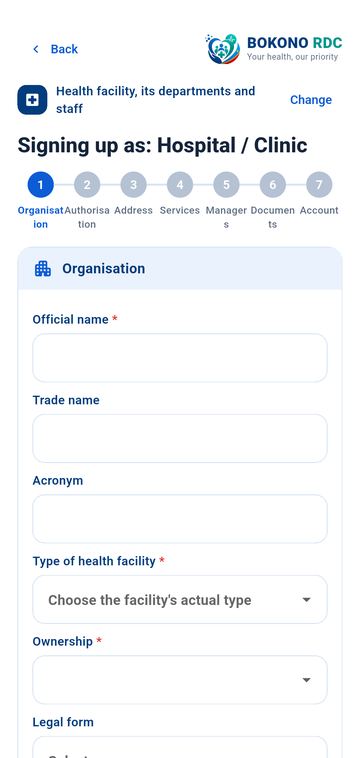
On "Who are you?", tap Hospital / Clinic.
The 7 steps of registering an organisation
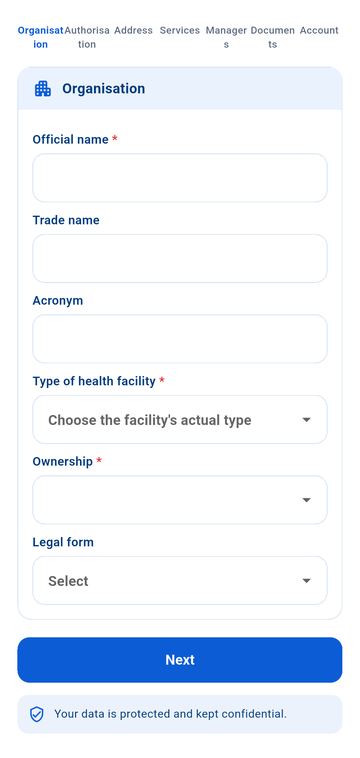
The form is filled in by the organisation's manager, or in their presence: the manager signs the declaration at the end. Fields marked with an asterisk () are required; tap Next* at each step.
- Organisation: type of organisation, official name, trade name, acronym, ownership (public, private, faith-based, NGO, other) and legal status.
- Authorisation: authorisation or licence number, issuing authority, legal identifiers (RCCM / NIF / ID Nat.), legal name of the operating entity, and the technical leads specific to your activity. These numbers are checked with the competent authority before any activation.
- Address: province, city or territory, commune and neighbourhood, address (avenue, number), GPS coordinates (optional), phone, email and website.
- Services: the services, hours and information specific to your activity (detailed below). Only tick what is really available: everything is checked.
- Managers: the manager (surname, middle name, first name, role, phone), the medical director if there is one, then 2 to 3 contact persons.
- Documents: photograph each legal document requested, legible and in full. Documents are encrypted and seen only by the verification team.
- Account: email address and password for the organisation's account, acceptance of the terms of use, then the signature: the manager's full name (the same as declared in step 5) and the two certification boxes. Tap Create an account.
Specific to health facilities
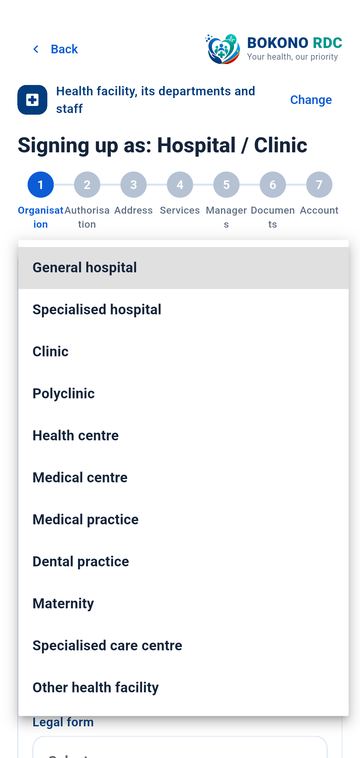
- In the Organisation step, the required field Type of health facility offers 11 types: general hospital, specialised hospital, clinic, polyclinic, health centre, medical centre, medical practice, dental practice, maternity, specialised care centre, other health facility (then specify which).
- In the Services step: emergency, maternity, paediatrics, surgery, imaging, laboratory, inpatient care, pharmacy, dental, ophthalmology; number of beds; on-call (days, hours); opening days and hours; payment methods and insurers accepted.
Signing in and protecting the app
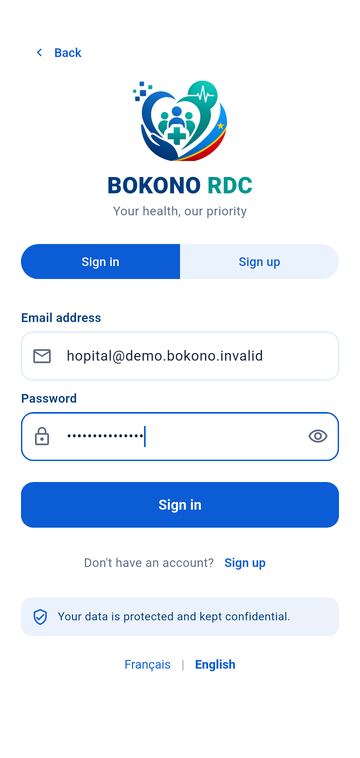
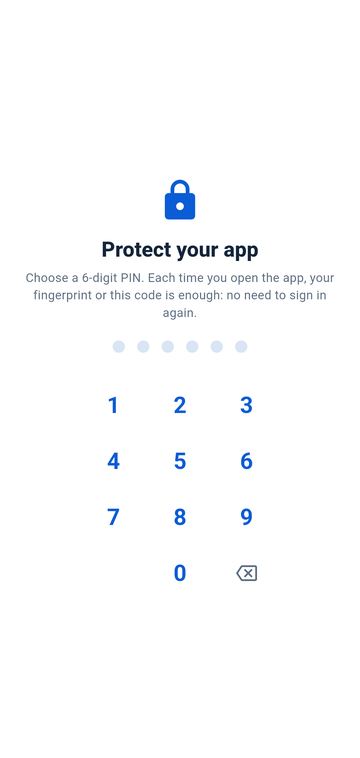
Once your account has been created, you sign in with your email address and password. After that, a 6-digit code (or your fingerprint) is enough to reopen Bokono.
- On the Sign in screen, enter your email address and password, then tap Sign in. The eye icon on the right shows or hides the password.
- "Protect your app": type a 6-digit code, then type it a second time to confirm it. If your phone has a fingerprint reader, turn on Also unlock with my fingerprint.
- Right after that, Bokono asks for access to the microphone (calls and teleconsultations), location (emergencies) and full-screen calls (answering even when the phone is locked). Tap Continue and accept.
- Each time you open the app, or after one minute away from it, place your finger or type your code. After 5 wrong codes, Bokono signs you out for security: sign in again with your password.
One phone at a time. If your account is already open on another device, Bokono shows "Account already signed in". Continue here signs the other device out; Cancel keeps it. Never share your password or your code.
Review of the organisation's file
After it is sent, the file goes for review. Until it is approved, the app only opens the file, help and notifications.
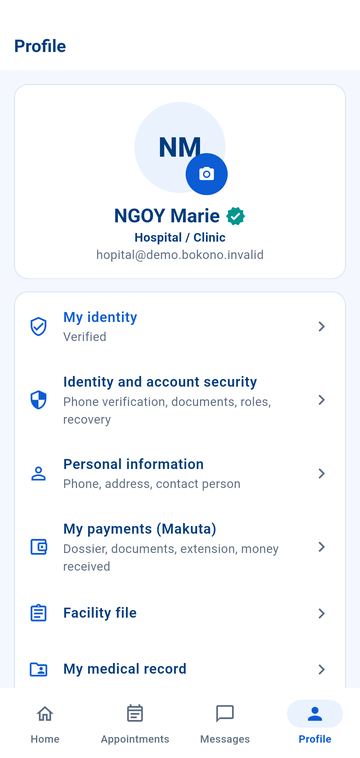
- Open Profile → Facility file: the status is shown at the top (pending, corrections requested, approved).
- If an agent requests a correction, the reason is shown: correct it, add the missing document, then tap Send for verification. Only the declared manager can sign.
- Once the file is approved, the Verified account badge appears on the home screen and the organisation's tools open. The official name, registration number and status can then only change through the verification process.
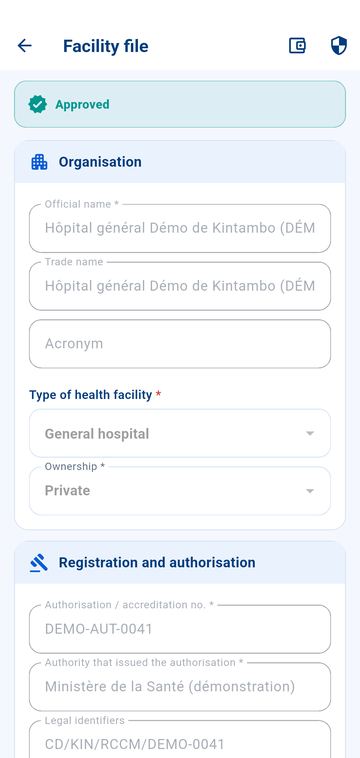
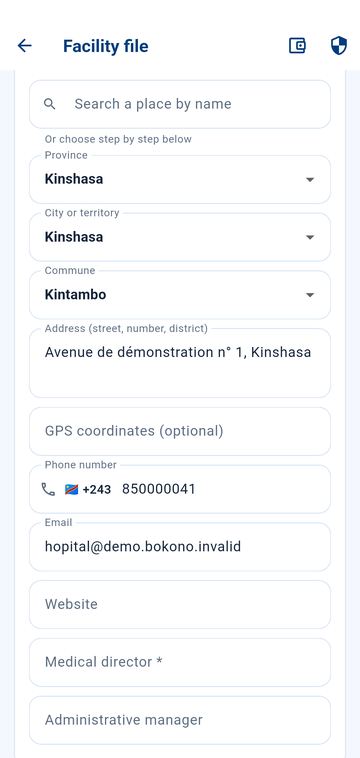
Internal ID. Bokono gives each organisation an ID internal to the platform. It is not an official number: your authorisation, RCCM, NIF or ID Nat. numbers remain those issued by the authorities.
Turning on two-factor authentication (required for professional actions)
Your professional actions — opening a record, prescribing, dispensing, validating, activating a membership… — require a second authentication factor. Until it is turned on, the professional space shows "Second factor required".
- Install an authenticator app on your phone (an app that shows 6-digit codes renewed every 30 seconds).
- In Bokono, open Profile → Account security (two-factor authentication).
- Scan the code shown with the authenticator app (or enter the key shown below the code).
- Enter the 6-digit code shown by the authenticator app, then tap Verify.
Bokono will then ask for this code when needed. The second factor can be turned on at any time, even before your file is approved. It is personal: one second factor per person.
The facility's home screen
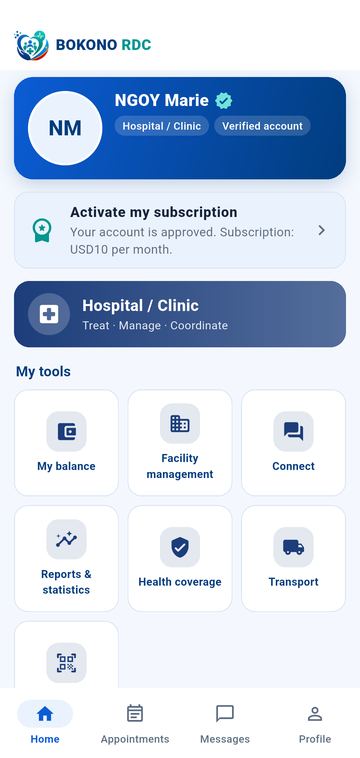
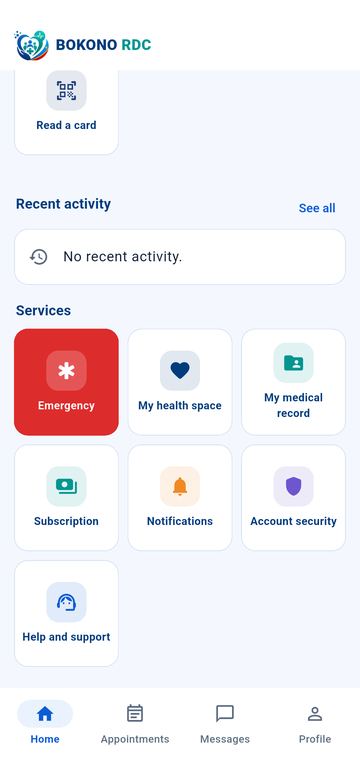
| Area | What it contains |
|---|---|
| Organisation card | Name, type and "Verified account" badge |
| Activate my subscription | Reminder until the subscription is paid |
| My tools | My balance, Facility management, Connect, Reports & statistics, Health coverage, Transport, Read a card |
| Recent activity | The latest events; See all for the full list |
Bottom bar: Home, Appointments, Messages, Profile.
Facility management
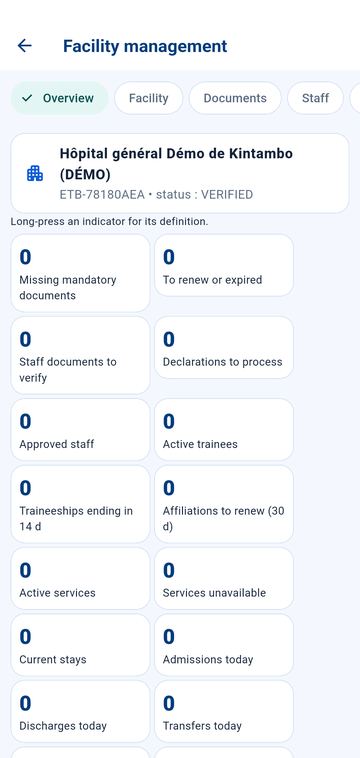
Facility management (home → Facility management)
The screen opens on the Overview: indicators (missing required documents, documents to renew, staff declarations to process, approved staff…). A long press on an indicator shows its definition. The tabs at the top give access to the details:
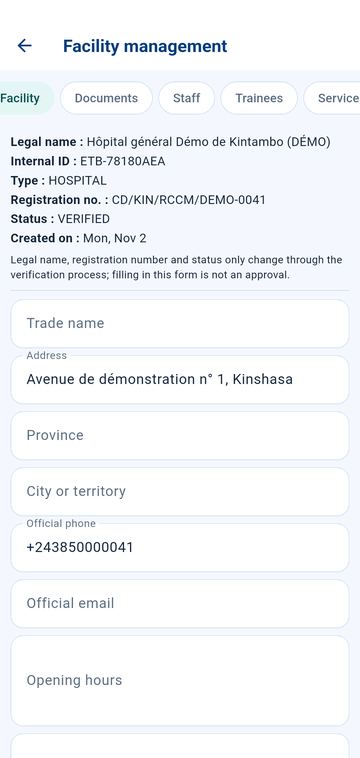
- Facility: trade name, address, province, city, official phone and email, opening hours and operational information; tap Save. The official name, registration number and status only change through verification.
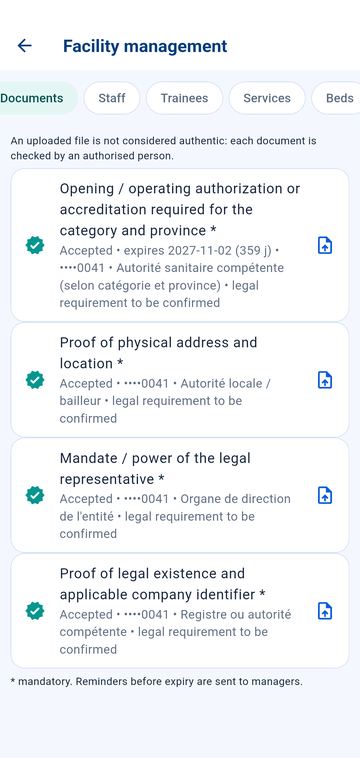
- Documents: the documents required for your type of organisation, their status (to provide, under review, accepted, refused, corrections requested, expired, to renew) and their expiry date. An uploaded file is not considered authentic: each document is checked by an authorised person. Reminders are sent to managers before expiry.
- Staff: your staff declarations (see below).
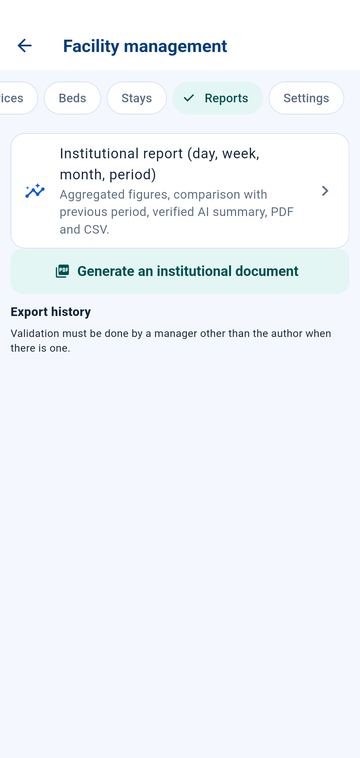
- Reports: the institutional documents generated and their validation.
- Settings: the documents requested for staff declarations (internal rules in addition to the platform's rules).
Departments, beds and stays
Services (Facility management → Services)
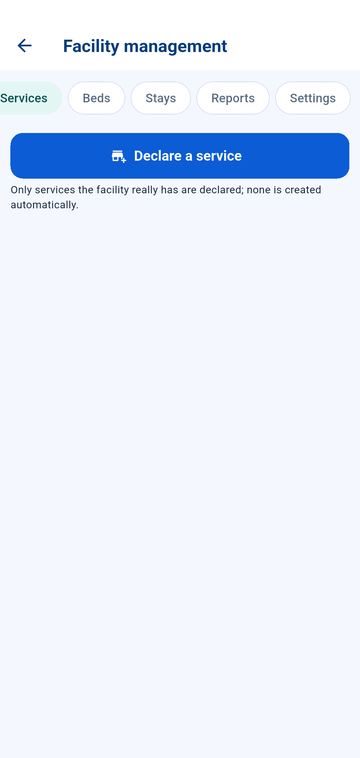
- Tap Declare a service: type of service (outpatient, emergency, inpatient, maternity, paediatrics, surgery, internal medicine, laboratory, imaging, pharmacy, intensive care, ambulance, other unit), name, head of service, internal contact, declared beds and rooms.
- A service's status: Active, Temporarily closed, Being prepared or Unavailable. Every change needs a reason.
- Only declare the services the facility really has.
Beds (Beds tab)
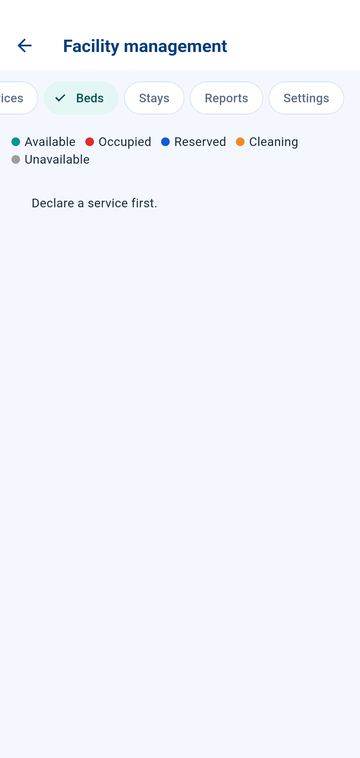
- Add a room or ward (building optional) and its beds, separated by commas (e.g. A, B, C).
- Each bed has a status: Available, Occupied, Reserved, Cleaning or Unavailable.
- From a bed: Assign to a current stay or Release bed.
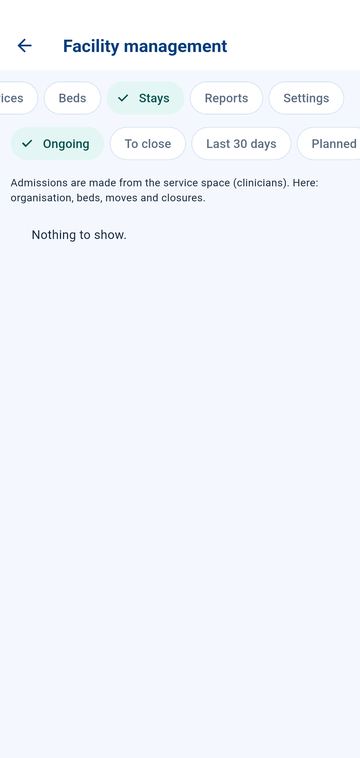
Stays (Stays tab)
- Plan an admission: patient name or reference (no medical reason), service, date and administrative note; tap Plan. Admissions themselves are made from the department's space, by caregivers.
- For an ongoing stay: Move to another service, Set planned discharge, then Administrative closure (home, another facility, other). Medical discharge is decided by the caregiver in their own space.
- Statuses: Ongoing, Discharged, Transferred, Left against advice; the tab flags stays to close.
The available beds you keep up to date help paramedics and emergency responders direct patients to a facility that can receive them.
Staff and trainees
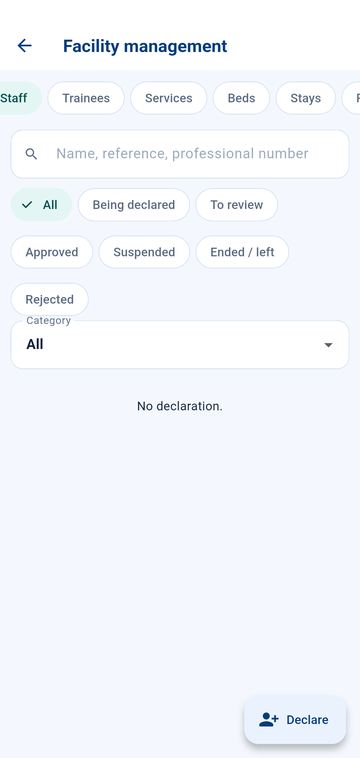
Declaring your staff (Facility management → Staff)
- Tap New declaration.
- Identity: surname, middle name, first name, date of birth (it helps avoid duplicates), phone, email.
- Role and engagement: professional category (general or specialist doctor, nurse, midwife, lab technician or biologist, pharmacist, technician, administrative and technical staff…), specialty, professional number, type of engagement (employee, contractor, authorised volunteer, other), department, role or position, start and end dates.
- Tap Save. If an ongoing declaration looks like this one (same account, same professional number, or same name and date of birth), Bokono flags a possible duplicate: check before continuing.
- From the declaration page, upload the supporting documents requested (10 MB maximum per file), then tap Submit.
- A manager takes it for review, checks each document (Accept or Decline with a reason), then Approve, Request information or Decline.
- If the person has a Bokono professional account, link it (Link) or give them the link code: they enter it in Profile → My facility declarations.
Approval is internal to the facility: it is not an official licence. Professional access to the department only opens if the person has confirmed the link, their qualification is verified by Bokono and they are not in training.
The page then lets you record movements (change of department or role, renewal or extension), Suspend or Reactivate, and Record departure. Professional access is adjusted automatically. The history is kept.
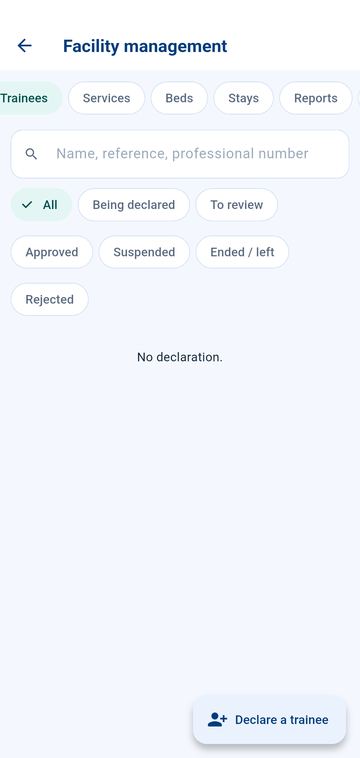
Trainees (Trainees tab): Declare a trainee (intern, resident or trainee) with their responsible supervisor, training institution or partner body, programme or type of placement, objectives and period. A trainee gets no automatic professional access. At the end of the period, Close the traineeship with an administrative evaluation and, if you wish, issue a traineeship certificate.
Activity and reports
The facility's account is used to manage the organisation. Care actions — viewing a record, prescribing, giving a treatment, planning a task — are done from the professional accounts of the linked caregivers (see the "Doctor", "Nurse" and "Midwife" manuals). Record access always follows patients' consent rules and every access is logged.
Reports & statistics (home → Reports & statistics)
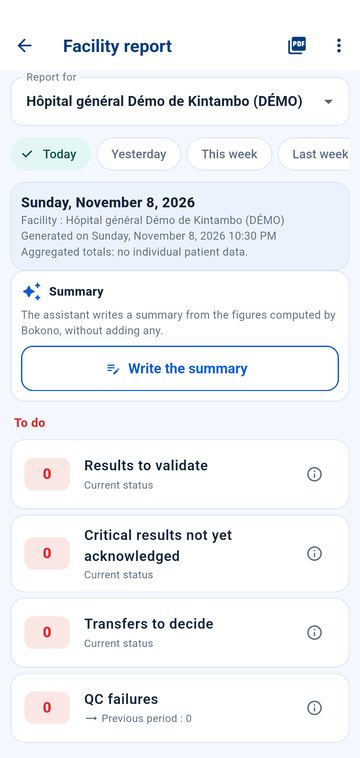
- Choose the period (today, yesterday, this week or another period offered). The figures only count what is recorded in Bokono; the i explains each figure.
- Write the summary: the assistant writes a summary from the calculated figures, without adding any; you review it.
- The PDF icon exports the report.
Institutional documents (facility sheet, list of departments, declared staff, document status, capacity and beds, periodic report) are generated in Facility management → Reports → Generate. Each document must be validated by a manager — someone other than its author where there is one — before being sent anywhere. The official format remains to be confirmed with the receiving authority.
Health coverage and transport
Patients' health coverage (home → Health coverage)
For insured patients or mutual members, the organisation checks coverage and sends its invoices to the insurer directly in Bokono.
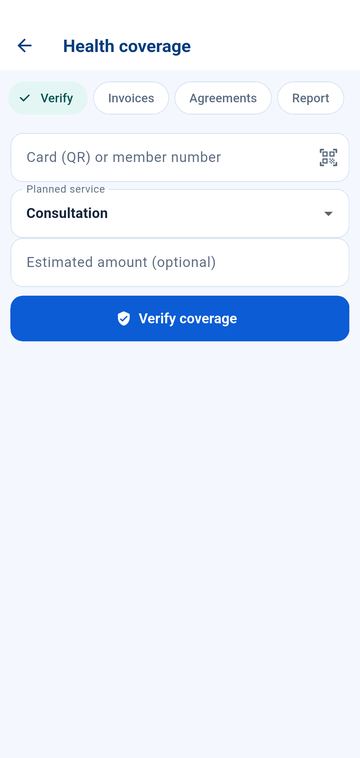
- Verify: scan the beneficiary's card (QR) or enter their number, state the planned care and, if you wish, an estimated amount, then tap Verify coverage. The answer says, for example: potentially eligible, excluded or in a waiting period, prior authorisation needed, coverage expired, or facility not covered by an agreement in force.
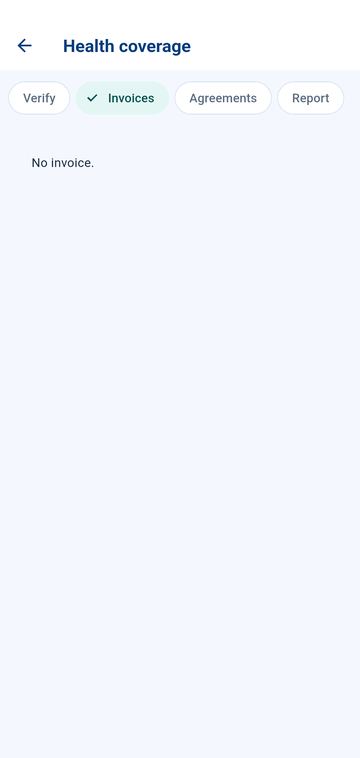
- Invoices: Prepare the invoice, add each service (label, agreement tariff code, quantity, unit price, date of care), then Submit. Only attach the medical information that is necessary. Bokono flags a similar invoice already submitted. Then follow the status (submitted, under review, accepted, partially accepted, contested, refused, awaiting payment, paid, closed), the insurer's share, the patient's share and the balance due.
- Agreements: submitting an invoice requires an agreement in force with the insurer. Propose an agreement (services, tariffs, pre-authorisation, invoice and payment deadlines, disputes); by proposing, you sign for your organisation, and the agreement becomes active when the insurer signs in turn.
Active coverage does not guarantee that all care is covered. Emergencies must never wait for this check.
Medical transport (home → Transport)
To have a patient transported by an ambulance service registered on Bokono:
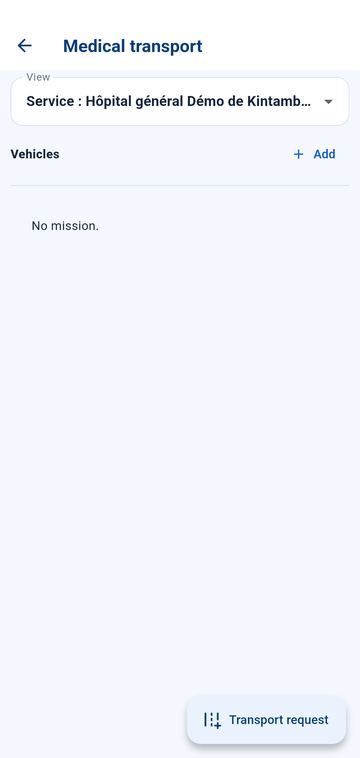
- Tap Transport request.
- Choose the ambulance service, enter the pick-up location, the destination (facility), the reason and the priority according to the local protocol (immediate, urgent or scheduled). Add the information available about the patient.
- Tap Send request. Then follow the status: Request received, Awaiting regulation, Assigned, Crew en route, On scene, Patient on board, In transport, Handed over, Completed.
In a life-threatening emergency, use the emergency procedure and call emergency services: a transport request does not replace an emergency alert.
Messages and calls: Bokono Connect
Never use messages for an emergency: use the red Emergency button or call emergency services.
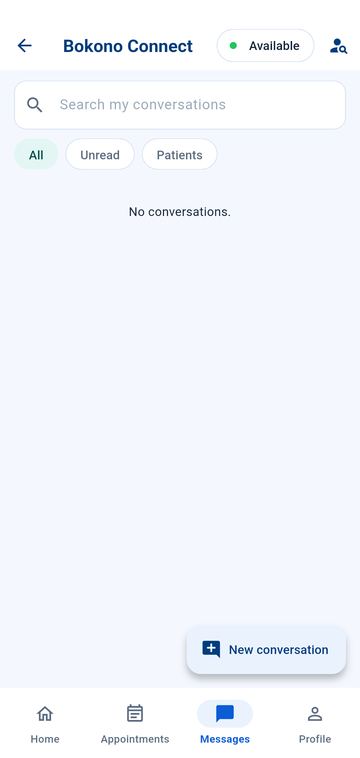
- Tap Messages in the bottom bar (or the Connect tile on the home screen). Conversations are listed with the most recent at the top, messages grouped by day; the All and Unread filters and the search bar help you find an exchange.
- New conversation: search for a registered person or organisation by name, profession or Bokono ID.
- The name and photo of the person you are talking to appear at the top of the conversation. You can send text, photo, document or voice message. Without a network, the message waits on the phone and is sent automatically when the network returns; it is never shown as "sent" before then.
- To call, tap the phone icon (audio) or the camera icon (video). The screen shows "ringing", "busy" or "unreachable". An incoming call rings even when the phone is locked: tap Answer in the notification. The call opens directly, with no intermediate screen and no Bokono code; the code is asked again after the call. No other window opens during a call. Calls are never recorded.
- The Available switch at the top of the Messages screen tells others whether you can be called right now (green or red dot).
Subscription, profile and help
Paying the subscription by mobile money
Payment is made directly in the app, by mobile money. It is only requested once the account has been approved.
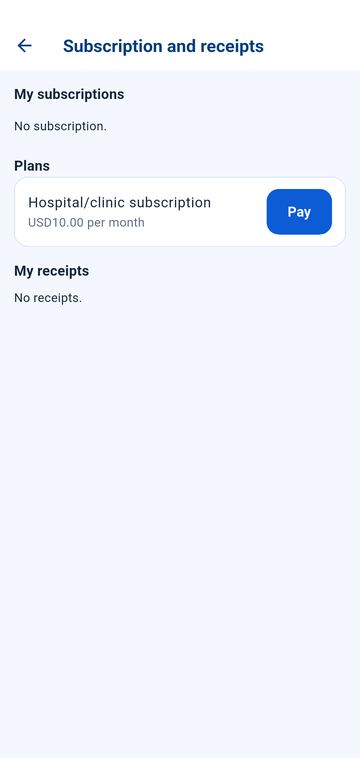
- Tap the Activate my subscription card on the home screen (or Payments, or Profile → Subscription and receipts).
- Under Plans, tap Pay next to the plan that matches your account; the monthly price is shown.
- Enter your mobile money number in international format (e.g. +243 81 234 5678), then tap Pay by mobile money.
- Approve the payment on your phone (message from your operator and your mobile money PIN).
- Return to Bokono and tap Check payment. Once the payment is confirmed, the subscription is active and your receipt appears in My receipts.
If the payment does not go through, no amount is recorded: you can try again. A payment already in progress must be completed or checked before starting another one.
My balance and Makuta dossier
Patients' payments for your services go through Makuta, Bokono's payment provider.
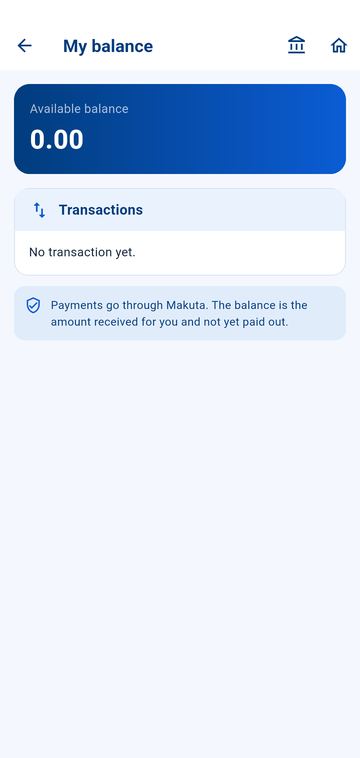
- Tap My balance: it is the first tile of your professional tools (or the Balance button at the top of the professional space).
- Available balance: the amounts received for you and not yet paid out. Below: the Total received and the list of Transactions (payment received, payout), with their status: received, pending, payout prepared, paid out, refunded…
- The icon at the top right opens My payments and Makuta dossier. This dossier is created automatically when you sign up, from the documents already provided to Bokono. The screen shows money received, payouts, the dossier status (in preparation, under review, sent to Makuta, payment extension active, to be completed) and the status of each document (being verified by Bokono, verified by Bokono then by Makuta, correction requested, rejected — to be replaced).
- The To provide list shows missing documents. A rejected document or one needing correction is replaced in your professional application file: it is picked up automatically and goes back for review.
The dossier is only sent to Makuta after Bokono has verified your documents and an administrator has validated it. Bokono never asks for your mobile money PIN.
Notifications (bell at the top of the home screen)
- The list shows your notifications, most recent first; tap one to open the screen it concerns. Mark all as read clears the red counter.
- Show message text in notifications: when off, the notification only says "New message from …"; when on, anyone who sees your phone can read the text.
- If notifications are blocked on the phone, a banner says so: allow them in the Android settings.
- Required permissions: as soon as you sign in, Bokono requires running in the background. The "Required permissions" screen lists what to turn on: notifications, running in the background (tap "Allow"), auto-start on some phones (Tecno, Infinix, itel, Xiaomi, Oppo, Vivo, Huawei…), background data, full-screen calls, microphone and camera, location. Tap Turn everything on, then Turn on on each remaining line: the app opens as soon as everything is on. The Emergency button stays available. If a permission is removed later, the screen comes back. Calls then ring and can be answered directly, even when Bokono is closed or the phone is locked, with no code or fingerprint during the call.
Help and support (Profile → Help and support)
The Frequently asked questions cover common situations. For anything else, tap Contact Bokono support, choose the subject (My account, Payment, Technical issue, Other question) and describe your request: the answer arrives in Bokono Connect. You can also write to support@bokono-rdc.net or call +243 850 655 988.
General hospital
A general hospital usually brings together all the functions described in this manual. Recommended set-up:
- Services: declare each department really open (emergency, internal medicine, surgery, maternity, paediatrics, intensive care, laboratory, imaging, pharmacy…) with its head.
- Beds: record rooms and beds department by department, then keep their status up to date; this feeds the "Available beds" and "Occupied beds" indicators.
- Staff: declare doctors, nurses, midwives, technicians and administrative staff; link interns and residents in Trainees.
- Stays: plan admissions and follow administrative closures every day ("Stays to close" indicator).
- Health coverage: propose agreements to your patients' insurers and mutuals, then submit your invoices in Bokono.
- Reports: generate the periodic report and have it validated by a second manager before sending it.
Specialised hospital
A specialised hospital focuses on one discipline. Points to watch:
- Only declare the departments really available, naming the specialty clearly (e.g. "Inpatient — cardiology").
- Specialist doctors declared in Staff appear with their verified specialty; this is what patients and referring colleagues see.
- Use Agreements to set out for insurers and mutuals the specialised procedures, their tariffs and the pre-authorisation rules.
Clinic
A clinic is most often private and combines consultations and inpatient care. Points to watch:
- Services and Beds: declare the units and beds actually in use; keep bed status up to date.
- Staff: in the type of engagement, distinguish employees from contractors (visiting doctors).
- Health coverage: check patients' coverage before planned care, never before an emergency.
Polyclinic
A polyclinic brings together several specialties, often as outpatient consultations. Points to watch:
- Declare one Services line per specialty or consultation unit, with its head and internal contact.
- The Schedule of linked practitioners receives patients' appointment requests.
- Reports & statistics let you follow activity by period.
Health centre
A health centre provides local care. Points to watch:
- Declare the basic services really offered (consultations, nursing care, maternity, laboratory…).
- Declare nurses and midwives in Staff: they carry most of the follow-up in Bokono (care, vital signs, handoffs, pregnancy follow-up).
- Use Transport to organise referrals to hospital with a registered ambulance service.
Medical centre
A medical centre combines doctors' consultations and care. Points to watch:
- Declare the consultations and care units really open, and your hours in the Facility tab.
- Linked doctors manage their appointments in their own Schedule; the facility follows the whole in Reports & statistics.
Medical practice
A medical practice brings together one or a few doctors. Points to watch:
- Management stays simple: Facility tab (hours, phone), Documents (authorisation up to date) and Staff (the doctor or doctors, any secretary).
- Each doctor keeps their own professional account, schedule and patients; the practice's account is used to manage the organisation.
Dental practice
A dental practice is declared like other facilities. Points to watch:
- Tick the Dental service at registration and declare it in Services.
- Declare dental surgeons and assistants in Staff with their documents.
- In Agreements, set out for insurers and mutuals the dental procedures covered and their tariffs.
Maternity
A maternity unit follows pregnant women, delivery and newborns. Points to watch:
- Declare the Maternity service (and Paediatrics or neonatology if it exists), the rooms and the beds.
- Declare midwives and doctors in Staff: in their own space they keep the pregnancy records, labour monitoring, delivery and postnatal follow-up. Each newborn gets their own record, linked to the mother.
- Prepare emergency referrals with Transport.
Specialised care centre
A specialised care centre offers a targeted activity (e.g. dialysis, rehabilitation, care of a chronic condition). Points to watch:
- Name each service clearly in Services so that patients and referring doctors know what is offered.
- Linked caregivers use Tasks & alerts for repeated care (sessions, monitoring) and their Schedule for appointments.
Other health facility
If your facility matches none of the previous types, choose Other health facility and specify its exact type at registration. The type given is checked with your documents. The functions described in this manual apply in the same way; only declare the services, beds and staff really present.
Frequently asked questions
| Problem | What to do |
|---|---|
| The signature is refused at registration | The full name signed must be exactly that of the declared manager, and both boxes must be ticked. |
| An indicator looks wrong | Long-press the indicator: its definition appears. Figures only count what is recorded in Bokono. |
| A caregiver has no access to the department | They must have confirmed the link (code), have a qualification verified by Bokono and not be in training. |
| A document is about to expire | Upload the new version in Documents before the date: reminders are sent to managers. |
| The invoice cannot be submitted | An agreement in force with the insurer is required: Health coverage → Agreements. |
| I want to change the official name | It only changes through the verification process: write to support. |